
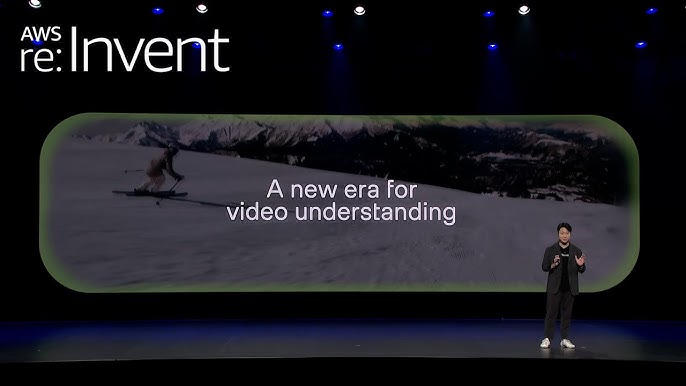
A New Era at AWS re:Invent 2025
A fresh perspective on what AI is capable of was the focus in this year of AWS re:Invent, which is the annual flagship conference of Amazon Web Services. It was not a focus on incremental improvements to the cloud, but rather a fresh perspective of what AI can do. AWS demonstrated a broad category of innovations: very strong new infrastructure, updated foundational models, and above all, a new type of agentic AI that extends well beyond chatbots.
In the center of the announcement: Frontier AI workers – autonomous, context-aware, persistent AI workers, which are meant to cooperate with humans or even work days on their own.
The AWS leadership message was quite obvious: the days of reactive chatbots may be over, and the new age of autonomous and proactive AI agents is dawning.
Here’s a long, informative and engaging article about AWS re:Invent 2025 and how this year’s standout headline — Frontier AI agents — signal a shift from traditional chatbots to autonomous, agent-based AI workflows.
What Are Frontier AI Agents — and How Do They Differ from Chatbots?
From Reactive Chatbots to Proactive Agents
Chatbots
Chatbots and conversational AI tools have performed well since the ancient times of limited and reactive tasks: responding to user queries, simple workflows, basic automation. They are session models in terms of interaction, in the sense that once the conversation stops, the context usually stops as well.
Frontier AI Agents
Frontier AI Agents are more than just a tool for dialogue: It is a self-sufficient, goal-oriented digital coworker. They can plan, reason, coordinate across tools, have long-term memory, and carry out multi-step tasks without the need for a user prompt.
In short: instead of “Hi, how can I help you now?”, think “Here’s what needs doing — I’ll take care of it over time, and update you.”
Core Capabilities that Elevate Agents Over Chatbots
Persistent Context & Memory
Frontier agents retain context across sessions (e.g. codebases, project history, infrastructure state). They “learn” from previous work and remember user or organizational preferences.
Autonomy & Multi-Step Task Execution
They are capable of working hours or days without needing human attention, address non-trivial tasks, such as bug triage, code refactoring, security reviews, Devops incidences, etc.
Deep Integration Across Tools & Workflows
These agents successfully automate the real-world ecosystems of development and operations, GitHub, CI/CD pipeline, security, and infrastructure monitoring across data silos.
Broad Scope: Beyond Text — Toward Multimodal & Infrastructure-Level Work
Coupled with AWS’s new model and infrastructure offerings, the agent framework is built to support everything from code generation to security, DevOps, and potentially more domains in the future.
In many ways, Frontier agents are the logical evolution of generative AI — from “assistants” to “autonomous collaborators.”
The First Wave: The Three Frontier Agents from AWS
At re:Invent 2025, AWS debuted three purpose-built frontier agents, each targeting a critical domain:
Kiro autonomous agent
A “virtual developer.” Unlike simple code-completion tools, Kiro can triage bugs, propose fixes, navigate multiple repositories, and submit pull requests automatically (still under human review). It retains context over time, learns style and preferences, and helps teams reduce manual overhead.
AWS Security Agent
Focused on security. It is able to perform automated security reviews, analyze pull requests, and conduct on-demand penetration testing and monitor application security across the entire development lifecycle.This introduces proactive security attitude – in the past, sooner, and holistically than the conventional reactive strategies.
AWS DevOps Agent
Designed to help manage production infrastructure and operations: from mapping application resources and understanding infrastructure relationships, to incident detection, root-cause analysis, and operational recommendations. It helps bridge the gap between code and operations, aiming for more stable, reliable, and efficient deployments.
These agents mark the initial frontier; AWS suggests that this is “just the beginning” — we may see many more specialized agents across domains in the months and years ahead.
Underlying Power: Infrastructure, Models, and Tools Behind the Move
This shift is not just marketing — it’s backed by real infrastructure and deep investments. Some of the key enablers unveiled:
- Trainium3 UltraServers: New-generation AI training and inference chips/servers offering a significant performance jump — making long-running, compute-intensive agent workloads feasible at scale.
- Amazon Nova 2 (and the broader Nova model family): AWS’s latest foundation models for text, code, multimodal processing (text, image, audio, video), powering the reasoning and generative backbone of agents.
- Nova Forge and customizable model fine-tuning: Enterprises can build their own domain-specific models on top of Nova, using proprietary data — achieving higher specialization and better alignment with business contexts.
- AgentCore — Agent orchestration / execution framework: The “operating system” for agents that handles context, memory state, policy enforcement (to set boundaries and permissions), monitoring, evaluation — enabling safe, controlled, and production-grade deployment of agentic systems.
Together, these components create a unified pipeline: from raw compute, models, orchestration, to deployment and integration — giving enterprises a full-stack agentic AI platform under AWS. As one tech analyst put it: AWS now aims to “own the full vertical control plane of applied AI.”
Why This Signals the “End of the Chatbot Hype Cycle”
Many observers interpret the re:Invent announcements as a turning point for enterprise AI — an official end to the hype around chatbots, and a move toward real, scalable, value-generating AI systems.
- From reactive to proactive: The re:Invent announcements are seen by many as a break in the development of enterprise AI, an official conclusion to the hype around chatbots and a transition to actual, scalable, value-generating AI systems.
- From narrow tasks to full workflows: The classic chatbot waits until the user types something. Meanwhile, frontier agents take action, plan and repeat – possibly satisfactorily completing workflows without human intervention.
- From pilots to production readiness: With infrastructure, orchestration, security guardrails (e.g. policy layers in AgentCore), and customizable models, AWS pitches this not as experimental — but ready for enterprise deployment.
In other words: chatbots were the “demo era.” Frontier AI agents may be the “industrial era” of AI.
Real-World Implications: What It Means to Companies, Developers and the Future of Work.
For enterprises and organizations
- Productivity boost: Some activities such as code review, bug triage, security checks and DevOps operations can be automated in part or entirely, and human teams can spend their time on strategy, design and innovation.
- Cost & time savings: Acceleration in code delivery, downtime reduction, higher security posture – possibly lowering the costs of operation and time-to-market.
- Flexibility and customization: Organizations can develop AI systems to their requirements of data governance, compliance and their data domains by configuring their own models (Nova Forge) and by deploying models on-premises (on-premises AI Factories) and in the cloud (hybrid).
For software developers and teams
- “Digital coworker” instead of tool: Developers may no longer just “use” AI tools — they’ll collaborate with them, treat them like junior teammates, handing off bugs, refactors, or even entire features.
- Easier scaling of capabilities: Small teams might get capacity comparable to much larger teams. Legacy codebases, technical debt — things that usually require manual labor — could be systematically addressed by agents.
For the broader AI ecosystem & the future of work
- Shift in AI adoption curve: Rather than hype driven experiments, we can expect actual adoption in industries, particularly where repetitive digital processes are prevalent, such as dev and ops, security, compliance, content generation, data analysis etc.
- New standards for safety, governance, and auditability: The more capitalistic the agents are and the stronger they are, the more robust guardrails will be required by the enterprise: policy controls, audit trails, evaluation regimes, ethical compliance. This appears to be what AWS predicts through such features as AgentCore Policy and evaluation tools.
- Potential disruption — and opportunity: The jobs previously aimed at routine functions can change. The engineers, security experts and DevOps workers may lean towards supervision, verification, design and upper-level decision making – as the real work is done by the agents.
But — What Are the Risks, Challenges, and What Remains Uncertain?
The shift to autonomous agents is promising — but not without caveats and open questions:
- Autonomy vs. Control: Allowing agents to act persistently, across multiple systems, introduces risk: mistakes could propagate widely. Recognizing this, AWS mandates human review for critical steps (e.g. pull requests, mitigation plans).
- Security & Data Governance: Agents require profound access to code, infrastructure, data. There should be proper configuration, permissions and policy guardrails. Businesses that fail to handle permissions have chances of data leakage, security breaches, or unintended disturbances.
- Suitability & Trust: Not every task or domain suits an agent. For highly sensitive, creative, or strategic work — human judgment and oversight remain crucial. The transition isn’t about replacing humans — but redefining collaboration.
- Overhype vs. Real Value: As with many AI “hype cycles,” there’s a risk of inflated expectations. The true value will depend on how well organizations adopt and integrate agents, manage change, and measure outcomes. Some industry analysts have warned about “agent washing” — calling out when old features are repackaged as “AI agents.”
Why This Matters — Not Just for Tech, but for Business & the Future of Work
The shift from chatbots to autonomous agents is more than a technical upgrade. It reflects a deeper transformation in how we think about AI — from “assistant” to “collaborator,” from “tool” to “team member.”
In the case of businesses, it implies that automation is no longer confined to limited and predictable functions. Entire processes, such as coding, security, deployment, maintenance, can be redefined.
To workers and teams, it provides an opportunity to get rid of monotonous and repetitive work and concentrate on creativity, strategy, and high-value labor.
And for the future of technology adoption overall, it signals the start of “agentic AI” becoming not just an experimental edge, but a core part of enterprise infrastructure.
If you think of AI progress in eras — the “assistant era” (chatbots, helpers) might soon give way to the “agentic era” (digital coworkers, autonomous systems). AWS re:Invent 2025 may be remembered as the moment that transition became real.
What to Watch Next
- The speed at which businesses in various industries embrace Frontier AI agents in production. Will mass automation of DevOps, security automation and code automation within businesses become common?
- How well AWS and other platform providers balance autonomy + control: robust guardrails, transparency, security, human-in-the-loop checkpoints.
- Expansion of agents beyond software development: customer support, data analysis, content production, compliance, operations, etc.
- Emergence of standards & best practices for agent deployment, evaluation, safety, and governance.
If you are looking for high-quality web or app development services feel free to drop us a message. We’re always happy to help you bring your digital projects to life!